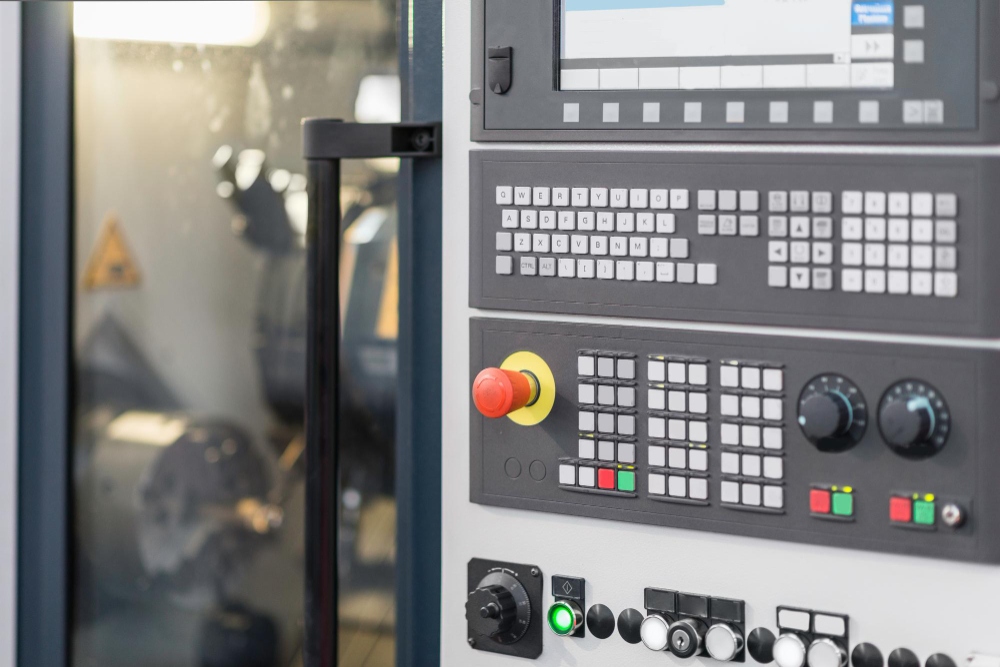
Modbus is one of the most widely adopted industrial communication protocols in the world. As an open and vendor-neutral standard, Modbus has powered industrial automation systems for decades and continues to be the backbone of factory floors, energy systems, and embedded controllers.
Modbus supports Server (Slave) and Client (Master) communication models and is commonly used in Programmable Logic Controllers (PLCs), Variable Speed Drives (VSDs), Human Machine Interfaces (HMIs), Data Acquisition Systems, Industrial Gateways and Controllers.
Despite its simplicity, Modbus remains relevant due to its deterministic behavior, low overhead, and ease of implementation—qualities that align perfectly with modern embedded and automotive-grade systems.

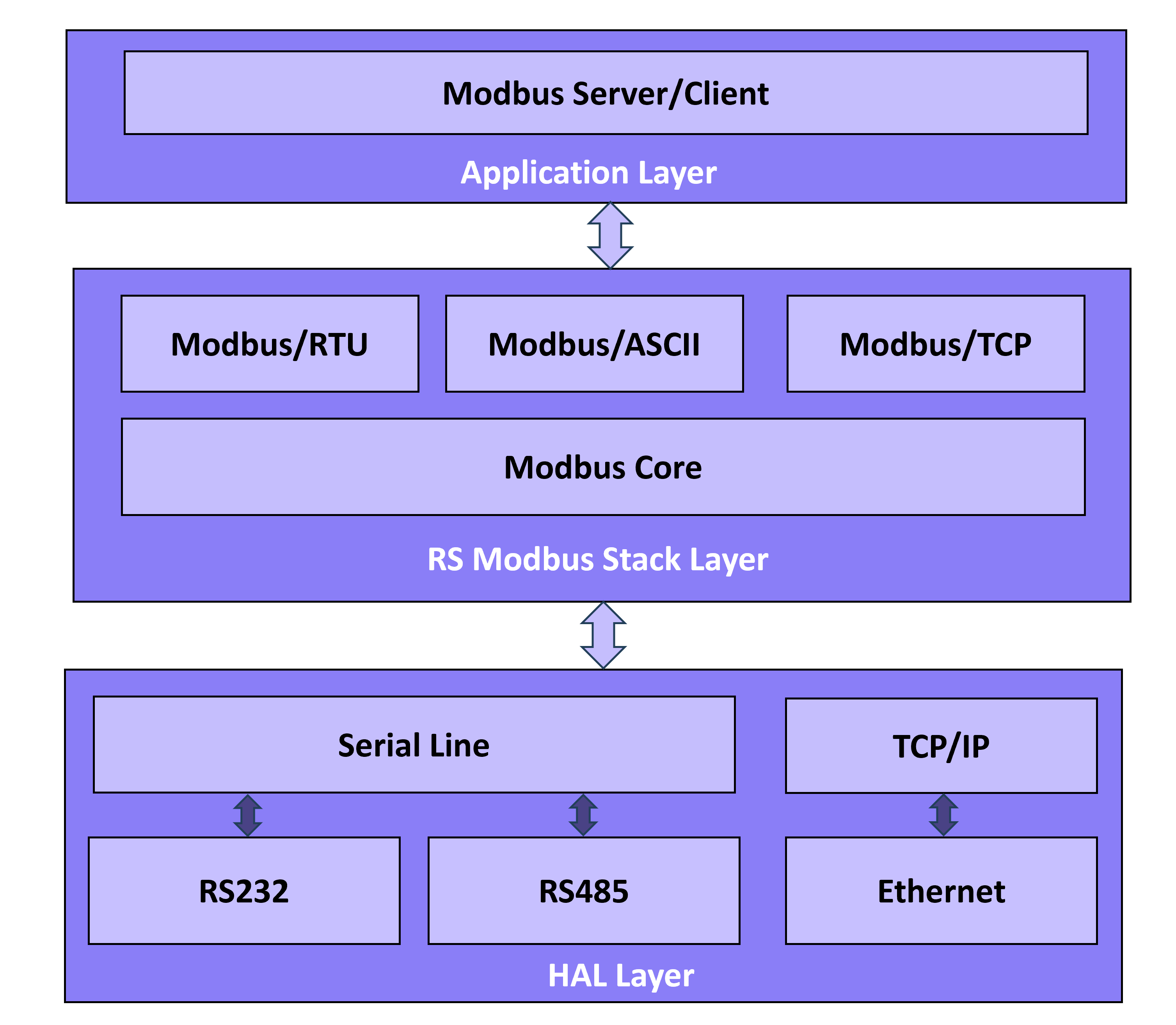
RAPIDSEA Modbus Protocol Stack is Embien’s robust implementation of the Modbus Application Protocol Specification v1.1, supporting both Server and Client configurations across multiple transports.
Our stack is designed to minimize integration effort, maximize portability, and deliver field-proven reliability, making it suitable for both legacy systems and next-generation embedded platforms.
Supported physical layers are Modbus RTU. Modbus ASCII , and Modbus TCP/IP, and supported operating models are bare-metal, RTOS-based systems, and Linux / Windows.
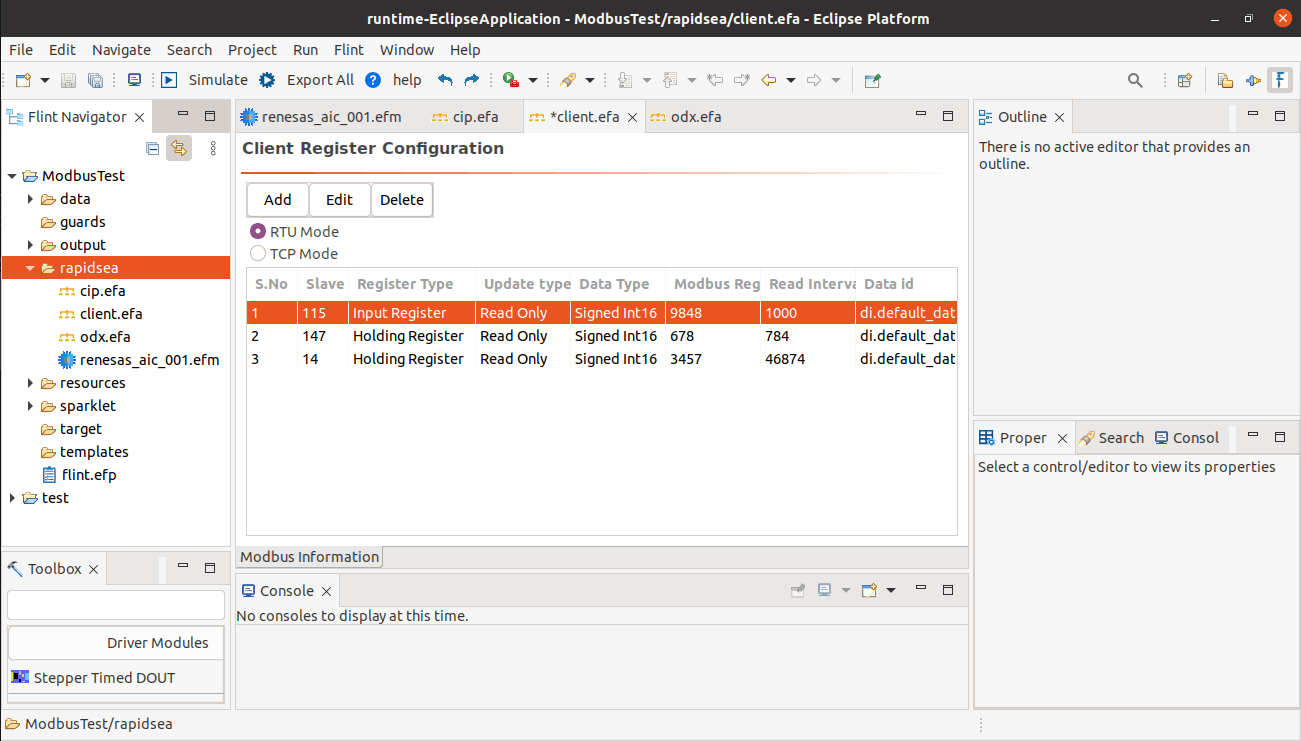
In addition to the core RAPIDSEA Modbus Protocol Stack, Embien also offers no-code development using Flint – a powerful, intuitive tool that empowers engineers to enable Modbus functionality without writing a single line of code. With Flint, the Modbus register addresses to be supported or accessed can be defined directly using the Flint Editor. Simply configure your setup, generate the code, and download it onto the target device – it will instantly start operating as a Modbus server or client, ready for seamless integration.
This approach supports extensive configurations tailored to your hardware and network needs, including baud rates (e.g., 9600 to 115200 bps), data formats (e.g., 8N1, 7E1), IP addresses for TCP setups, parity settings, stop bits, and more. Whether you're working with RS232, RS485 (RTU/ASCII modes), or Modbus TCP over Ethernet, Flint handles it all with drag-and-drop simplicity.
Leveraging Flint, you can quickly develop advanced applications like Modbus RTU gateways for bridging serial devices to modern networks, Modbus RTU to Ethernet/IP converters for legacy system upgrades, or Ethernet/IP to Modbus TCP protocol converters for cross-protocol interoperability. This accelerates prototyping and deployment, reducing time-to-market from weeks to hours.

The RAPIDSEA stack supports the full range of standard Modbus function codes, ensuring 100% interoperability with third-party devices like Siemens, Rockwell, and Schneider Electric hardware.
| Function Code | Name | Description |
|---|---|---|
| 01h | Read Coils | Read binary output status (On/Off) |
| 02h | Read Discrete Inputs | Read binary input status from sensors |
| 03h | Read Holding Registers | Retrieve configuration and analog output values |
| 04h | Read Input Registers | Read analog input data from the field |
| 05h | Write Single Coil | Command a single binary output |
| 06h | Write Single Register | Update a single internal parameter or setpoint |
| 0Fh | Write Multiple Coils | Batch-update binary states for efficiency |
| 10h | Write Multiple Registers | High-speed data synchronization for complex parameters. |
| 2Eh | Write Data By Identifier | Advanced diagnostic and identification writing |
Beyond standard codes, our stack includes Application-Specific Logic via APIs, allowing you to create custom function codes for proprietary diagnostic tools or specialized data types.
Our Modbus protocol stacks are used by various clients and we have deployed them over many time. With this experience, we have created an optimal flow, where the customers can quickly incorporate and validate in their design in a matter of just half an hour. Guided by our expert team and extensive documentation, make your device speak the language of Modbus.
Designed and developed by architects in the industrial automation domain software development, our stacks are written in compliance with the standard. Optimized for both speed and size, the Modbus Server and Client stack has been validated both by certification software and practically in the field with hundreds of devices, PLCs, SCADA systems, HMIs etc.
Leverage the power of low-code development without writing a single line of code to enable the Modbus functionality. With our Flint tool, developers can drag and drop the stack module, configure the registers and associated data with the convenience of the mouse. Only the data from business logic has to be updated via only two API's.
RAPIDSEA Modbus Protocol Stack is engineered for maximum portability and platform independence. It operates seamlessly across a wide range of MCUs, MPUs, and operating environments, delivering consistent Modbus functionality from resource-constrained controllers to high-performance processors. With broad compiler and OS support, the stack integrates easily into industrial and embedded systems.
RAPIDSEA Modbus stacks are supported for the following Renesas MCUs and MPUs


All the leading MCU and MPU families from the NXP and erstwhile Freesscale


Industrial and General purpose processing families from Infineon including


MCUs and MPUs from all spectrum of computing offered by ST Micro


Texas Instrument ARM based MCUs and higher end SITARA/OMAP processing platforms


ARM, PIC and Atmega family of MCUS and MPUS offered by Microchip are supported


MCUs from other leading vendors such as


Our stacks can be readily compiled for different toolchains including


Leverage Modbus data for predictive maintenance, AI-driven analytics, and sustainable manufacturing.

Design certified converters across Modbus, EtherCAT, Profinet, BACnet, wireless protocols, and more.
Create real-time digital replicas of industrial and automotive systems.
Security audits, vulnerability mitigation, and secure protocol implementations.


Enables precise motor speed control and real-time telemetry, allowing SCADA systems to monitor current, torque, and thermal status on high-speed assembly lines.

Acts as the bridge between central PLC controllers and peripheral robotic components, ensuring synchronized movement and status reporting across the production floor.

Facilitates high-fidelity data acquisition from pressure transmitters, flow meters, and temperature sensors for closed-loop control in chemical and pharmaceutical plants.

Provides the digital interface for smart circuit breakers and protective relays to communicate fault data and power quality metrics to energy management systems.
Powers the communication for automated storage and retrieval systems (ASRS), managing the sensors and actuators that drive conveyor belts and sorting logic.

Retrieves detailed operational diagnostics, vibration data from CNC controllers to track tool wear and machine uptime for predictive maintenance schedules.

RAPIDSEA Modbus stack can be integrated easily using well-defined APIs and documentation. For non-coders, the Flint configurator enables zero-code integration.