Modern multimedia applications demand more than basic video handling; they require real-time performance, scalability, and intelligent processing. RAPIDSEA GStreamer Plugins bring GPU-accelerated multimedia processing under one unified framework, enabling developers to build high-throughput, low-latency, and AI-ready video pipelines.
Built on top of the industry-proven GStreamer multimedia framework, RAPIDSEA’s CUDA-enabled plugins leverage NVIDIA GPU acceleration to offload compute-intensive workloads from the CPU to the GPU, unlocking unmatched performance for next-generation video processing and streaming systems.

GStreamer is a powerful, open-source multimedia framework used to design applications for audio, video, and real-time streaming. Its modular, pipeline-based architecture allows developers to connect reusable processing blocks called plugins to form complex multimedia workflows.
The true strength of GStreamer lies in its extensible plugin architecture, which allows seamless integration of Custom processing logic, Hardware accelerators, Vendor-specific optimizations
RAPIDSEA builds on this flexibility by delivering production-ready, CUDA-accelerated plugins that integrate natively into GStreamer pipelines.
Media streaming system
Video surveillance systems
AI/ML-based video analytics
Industrial vision platforms

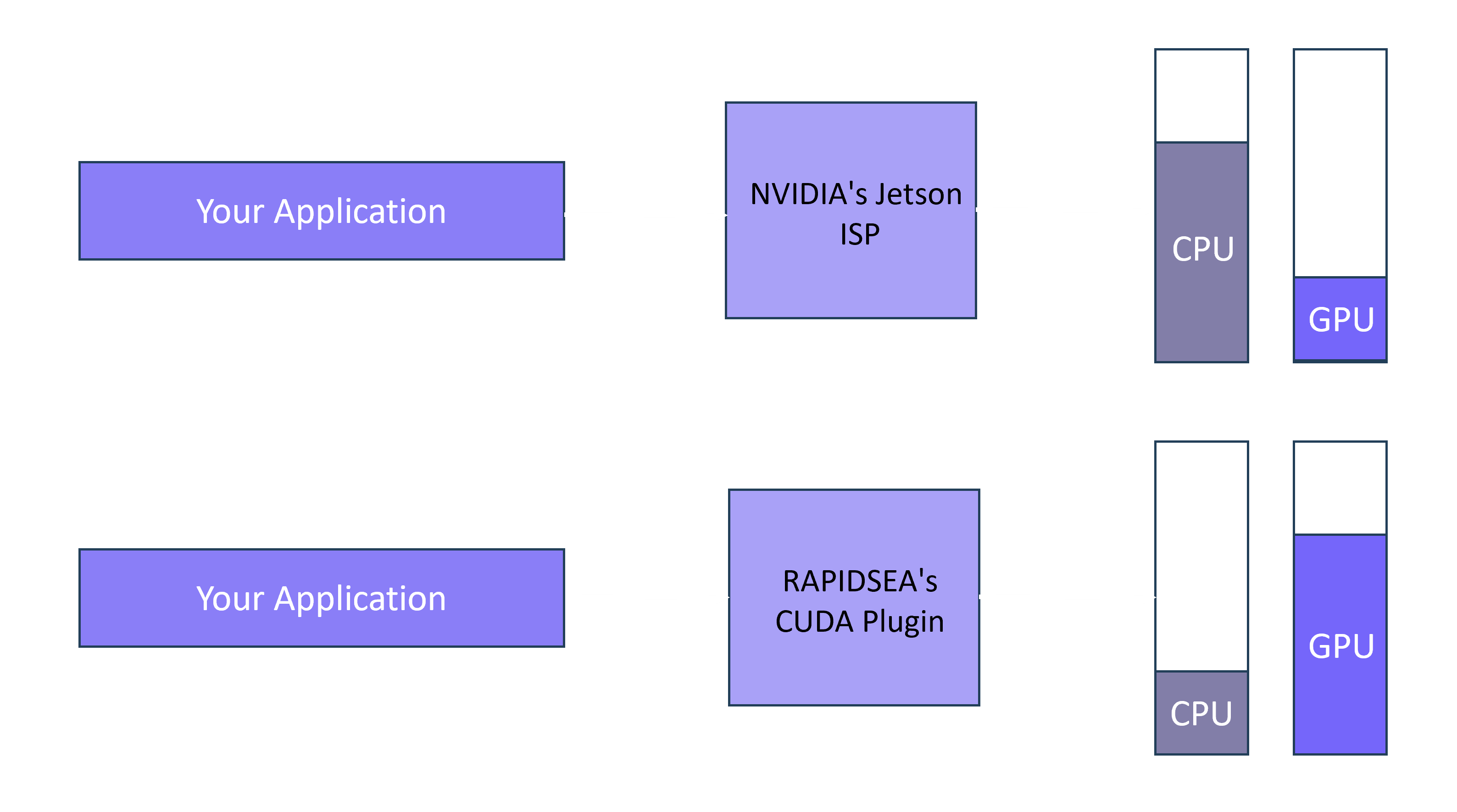
As multimedia workloads grow in complexity, CPU-based processing becomes a bottleneck. RAPIDSEA’s CUDA-enabled GStreamer plugins address this challenge by leveraging NVIDIA GPUs for parallel computation.
How CUDA Acceleration Works in RAPIDSEA Plugins
This architecture enables:
By combining GStreamer’s pipeline model with CUDA’s compute power, RAPIDSEA enables multimedia pipelines that scale effortlessly with workload demands.

GPU-resident video buffer processing

Zero-copy pipelines to eliminate CPU-GPU data transfers

CUDA kernel execution for custom algorithms

High-performance color space conversion

Real-time video transformations and filtering

GPU-accelerated encoding and decoding

Multi-stream and multi-pipeline support

Thread-safe and scalable architecture
RAPIDSEA GStreamer Plugins are designed for broad platform compatibility and seamless ecosystem integration.
Supported Platforms - NVIDIA Jetson Platforms:
The following NVIDIA Jetson boards support JetPack versions 4.5 and above:
Ecosystem Compatibility:


RAPIDSEA GST-CUDA Color Manipulation plugins enable high-performance video color processing within GStreamer pipelines using NVIDIA CUDA acceleration. Operations like brightness adjustment, contrast enhancement, binarization, and white balance correction run directly on GPU memory, delivering real-time frame processing, minimal CPU usage, & efficient zero-copy GPU workflows.

RAPIDSEA GST-Color Space Conversion plugin performs efficient format transformations within GStreamer pipelines to ensure compatibility between video processing stages. Using GPU acceleration, it converts formats such as GRAY8 or GRAY16 to NV24 while maintaining high throughput. This enables optimized video pipelines for encoders, AI inference engines, and display systems.

RAPIDSEA GST-SEI Handling plugins enable insertion and extraction of Supplemental Enhancement Information within H.264 and H.265 video streams in GStreamer pipelines. These plugins allow applications to embed metadata such as timestamps, sensor data, or custom payloads directly into video frames, supporting analytics, synchronization, and downstream video processing workflows.

RAPIDSEA plugins are not just accelerators, they are platform enablers. Some of their unique advantages are:

Handle high-resolution, high-frame-rate video streams with minimal latency.
Offload pre-processing and inference pipelines to the GPU for video systems.
Enable low-latency encoding, decoding, and real-time effects.
Support multi-camera pipelines with GPU-accelerated processing.
Perform real-time image transformations and analytics.
RAPIDSEA GStreamer Plugins are GPU-accelerated multimedia plugins that extend the GStreamer framework to deliver high-performance, real-time video processing using NVIDIA CUDA. They enable faster pipelines, lower latency, and scalable multimedia applications across embedded and server platforms.