Industrial Protocol Stack Integration for Smart Factory PLC Retrofit Using RAPIDSEA Modbus, ProfiNet and EtherNet-IP Stacks
Snapshot
RAPIDSEA supported an industrial automation systems integrator in building a production-ready smart factory gateway for a brownfield manufacturing plant retrofit. By deploying the RAPIDSEA Modbus, ProfiNet, and Ethernet-IP Protocol Stacks, the team delivered a multi-protocol industrial gateway — bridging legacy PLCs, motor drives, and field sensors to a cloud-connected production management system — in 10 weeks, without interrupting the plant's active production schedule or replacing any existing field hardware.
Customer Profile
Industrial automation systems integrator based in India, delivering factory digitisation solutions to discrete and process manufacturing clients across automotive, textile, and food processing sectors. Engagements typically involve retrofitting existing brownfield plants — installed bases of legacy PLCs, variable frequency drives, and field instrumentation — with data acquisition, production analytics, and remote monitoring capabilities.
Business Context
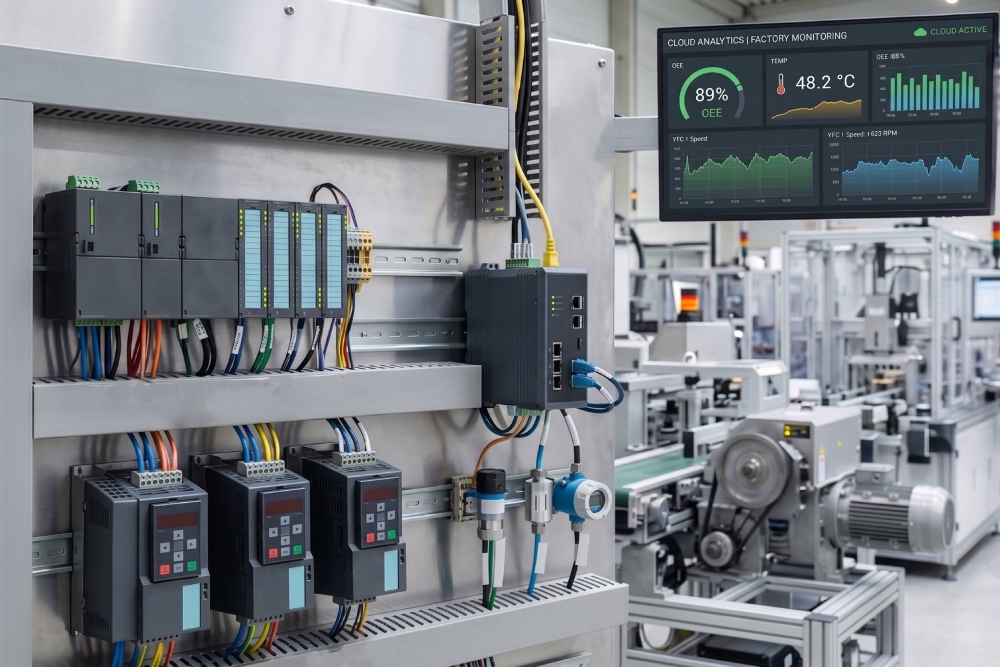
The target plant operated a mixed automation environment typical of Indian manufacturing: Siemens S7-series PLCs communicating over ProfiNet on the machining line, Allen-Bradley PLCs using EtherNet/IP on the assembly line, and legacy energy meters and flow sensors communicating over Modbus RTU on RS485. Three separate protocol islands with no common data layer. The customer's production management system needed a single gateway speaking all three industrial protocols simultaneously, normalising their data into a unified production data model.
Key Challenges
- Three-Protocol Simultaneous Operation: The gateway had to operate as a ProfiNet IO Controller on the machining line, an EtherNet/IP Scanner on the assembly line, and a Modbus RTU Master on the RS485 sensor bus — three independent protocol roles running concurrently without mutual interference.
- Brownfield Integration Without Production Disruption: The plant ran two shifts with no scheduled downtime window. The gateway had to be introduced passively — reading data from existing PLC outputs without modifying PLC programmes, adding network nodes, or interrupting existing SCADA communications.
- Legacy Modbus Device Diversity: The RS485 bus carried fourteen devices from six manufacturers — each with different register maps, baud rates, and response timing characteristics. A configurable polling engine was essential to cover this diversity without individual device customisation.
- IEC 61158 Compliance for Plant Network Acceptance: The plant's automation manager required any new network device to conform to IEC 61158 fieldbus standards before accepting it onto the production network. Non-compliant stacks risked rejection by the plant's automation vendor support agreements.
Target Platform
NXP i.MX RT1060 Cortex-M7 MCU — a high-performance real-time processor with multiple Ethernet MACs, dual CAN FD controllers, and hardware-accelerated cryptography. The platform provided sufficient processing headroom to run three simultaneous industrial protocol stacks alongside JSON serialisation and MQTT telemetry layers without task starvation. RAPIDSEA industrial protocol stacks' OS-agnostic MISRA-C architecture integrated cleanly with FreeRTOS.
Why RAPIDSEA
- Three Stacks, One Vendor, One Integration Model: RAPIDSEA Modbus, ProfiNet, and Ethernet-IP stacks share a common HAL abstraction and configuration architecture — a single integration model applying across all three protocol stacks, eliminating context-switching overhead of managing three independent third-party stacks.
- IEC 61158 Compliant Implementation: RAPIDSEA ProfiNet and Ethernet-IP stacks implemented in conformance with IEC 61158 fieldbus standards — satisfying the plant automation manager's compliance requirement and qualifying the gateway for acceptance onto the production network.
- Configurable Data Normalisation Layer: RAPIDSEA data object architecture — shared across all three protocol stacks — allowed the systems integrator to map PLC process variables from any of the three protocols into a unified production data model through a configuration table.
Solution: How to Build a Multi-Protocol Industrial Gateway for Factory PLC Integration
RAPIDSEA HAL Mapping on NXP i.MX RT1060
First Ethernet MAC shared between ProfiNet IO Controller and EtherNet/IP Scanner stacks — each on a dedicated VLAN with hardware MAC filtering. Second Ethernet MAC handled cloud uplink. RS485 UART mapped to the RAPIDSEA Modbus RTU HAL serial interface. Complete HAL bring-up across all five protocol interface instances completed in three days.
ProfiNet IO Controller Integration for Machining Line PLCs
RAPIDSEA ProfiNet Stack configured as IO Controller, reading process data images from four Siemens S7-1200 PLCs. GSD file parsing, slot and subslot assignment, and cyclic data exchange parameters handled through the RAPIDSEA ProfiNet configuration interface. Stack established cyclic connections to all four PLCs within minutes of first network connection — no PLC programme modification required.
EtherNet/IP Scanner Integration for Assembly Line PLCs
RAPIDSEA EtherNet/IP Stack configured as CIP Scanner, polling three Allen-Bradley CompactLogix PLCs via explicit CIP message requests. Production counter, cycle time, and fault code attributes read at 500ms intervals. IEC 61158 compliant CIP implementation accepted onto the Allen-Bradley network without exception from the plant's Rockwell Automation support agreement.
Modbus RTU Master: Configurable Multi-Device Polling Engine
RAPIDSEA Modbus RTU Master configured with a fourteen-device polling schedule. Each device entry specified Modbus address, register start, register count, baud rate, and inter-frame timeout independently — accommodating six manufacturers' differing timing characteristics. Full fourteen-device scan cycle completed in under 4 seconds at mixed baud rates.
Unified Production Data Model and Cloud Telemetry
Process variables from all three protocol stacks mapped into a unified production data model through a configuration table. JSON payloads published to AWS IoT Core via MQTT at 30-second intervals, with exception-triggered immediate publishes for fault code changes. Cloud dashboard received a single coherent data stream from all three protocol islands for the first time in the plant's operational history.
Engineering Impact
| Metric | Result |
|---|---|
| Time to SoP | 10 weeks across all 3 protocol integrations on NXP i.MX RT1060 |
| Production disruption | Zero — gateway introduced passively without PLC programme modifications or SCADA downtime |
| Modbus device coverage | 14 devices across 6 manufacturers from a single configurable polling table |
| IEC 61158 compliance | Accepted by plant automation manager — no vendor exception processes required |
| Production visibility | First unified data stream from 3 previously disconnected protocol islands |
| Deployment reuse | Gateway configuration reused on 2 subsequent plant sites — protocol profile tables only |
Conclusion
Bridging three simultaneous industrial protocol stacks — Modbus RTU, ProfiNet, and EtherNet/IP — from a single embedded gateway without disrupting an active production environment is precisely the integration challenge that makes brownfield factory digitisation projects expensive and slow. The RAPIDSEA industrial protocol stacks gave this systems integrator a unified, IEC 61158 compliant foundation covering all three protocols from a single vendor — delivering a smart factory gateway in 10 weeks and a reusable deployment template across subsequent plant engagements.
Contact our experts for a technical demo.
Frequently Asked Questions
The core requirement is a gateway firmware that can run Modbus RTU Master, ProfiNet IO Controller, and EtherNet/IP Scanner roles concurrently — each on its own network interface — while sharing a common data model above the protocol layer. The RAPIDSEA industrial protocol stacks provide this architecture with a shared data object layer and common HAL model. Device-specific configurations are loaded as runtime configuration tables without firmware rebuilds between plant deployments.