Automotive CAN Data Logger for AIS 140 Telematics Using RAPIDSEA CAN IVN Stack
Snapshot
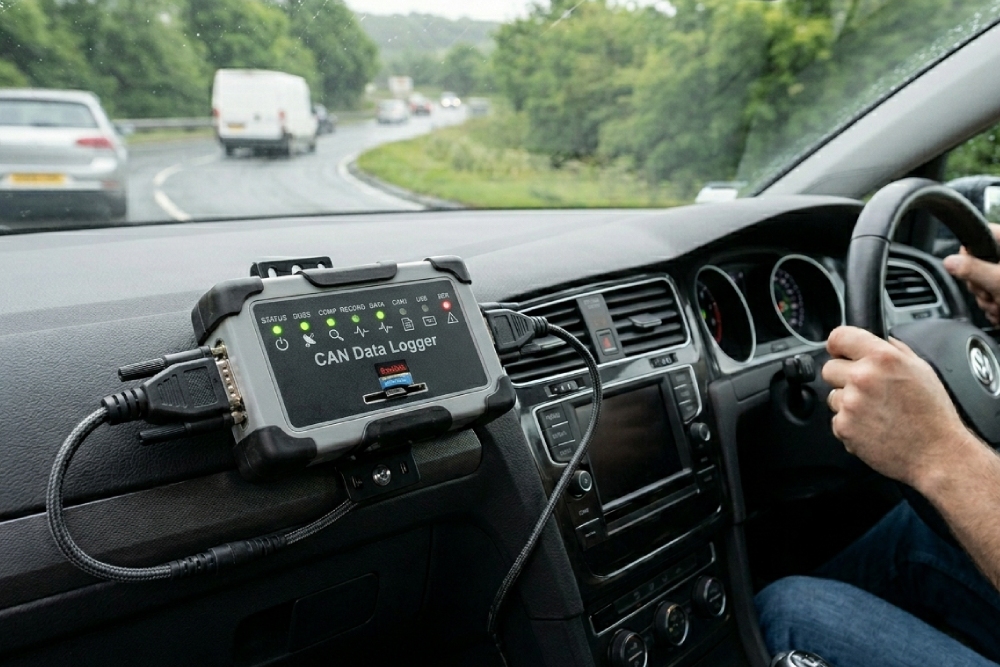
RAPIDSEA supported a Tier-1 telematics supplier in building a production-grade automotive CAN data logger for an AIS 140 certified 4G telematics unit. By deploying the RAPIDSEA CAN IVN Stack, the team eliminated custom CAN frame parsing infrastructure, achieved clean multi-parameter vehicle data acquisition across mixed DBC configurations, and reached SoP in 9 weeks, within the certification window mandated by the Ministry of Road Transport and Highways (MoRTH).
Customer Profile
Established Tier-1 telematics supplier serving commercial vehicle OEMs across India. Product portfolio includes vehicle tracking units, fleet management devices, and driver behaviour monitoring systems for bus fleet operators, logistics companies, and state transport undertakings, all subject to mandatory AIS 140 compliance under MoRTH regulations.
Business Context
AIS 140 is India's government-mandated standard for intelligent transportation systems, requiring commercial vehicles to carry certified GPS and emergency tracking units. The customer's existing data logger used a basic CAN receive loop with hardcoded DBC parsing. Scaling this across multiple OEM platforms with differing frame IDs, signal encodings, and CAN FD support was becoming unsustainable. They needed a production-ready embedded CAN stack for vehicle telematics supporting multi-OEM DBC configurations, CAN FD bitrates, and J1939-based heavy vehicle parameters within the same firmware binary.
Key Challenges
- Multi-OEM CAN Frame Diversity: Each commercial vehicle OEM uses a proprietary DBC mapping. The data logger needed to support runtime-configurable frame parsing across these mappings without firmware rebuilds per OEM variant.
- CAN FD and Classic CAN Co-existence: Newer vehicle platforms transmit high-density data over CAN FD, while legacy fleet vehicles still use classic CAN at 250/500 Kbps. The firmware had to handle both on the same hardware without separate code paths.
- J1939 Integration for Heavy Vehicles: A significant portion of the customer's fleet operated heavy commercial vehicles using SAE J1939. PGNs for speed, torque, and emissions data had to be parsed correctly alongside proprietary OEM frames.
- AIS 140 Certification Timelines: MoRTH certification involves third-party testing with strict pass/fail criteria on data accuracy and transmission integrity. Any instability in the CAN acquisition layer would cascade into failed test submissions and delayed certification.
Target Platform
NXP S32K148 MCU — a 32-bit Arm Cortex-M7 automotive-grade microcontroller with integrated CAN FD controllers and hardware security modules. Lightweight RTOS managing parallel tasks for CAN acquisition, GPS processing, 4G uplink, and local data buffering. RAPIDSEA CAN IVN Stack's hardware-agnostic HAL and MISRA-C compliant codebase integrated cleanly without rearchitecting existing firmware.
Why RAPIDSEA
- Configurable DBC-Based Frame Parsing: Runtime-loadable signal extraction configurations allowing the same firmware binary to handle multiple OEM DBC mappings — eliminating per-OEM firmware variants.
- Native CAN FD Support: Handles both Classic CAN (up to 1 Mbps) and CAN FD (up to 8 Mbps data phase) within the same API surface, with physical layer selection abstracted through the HAL.
- J1939 Compatibility: CAN IVN stack is compatible with J1939 PGN-based addressing, allowing parsing of heavy vehicle parameters alongside OEM-specific frames within the same acquisition pipeline.
Solution: How to Build an AIS 140 Compliant Automotive CAN Data Logger
CAN IVN Stack Embedded Integration: HAL Mapping on NXP S32K148
Integration began with mapping the S32K148's FlexCAN controllers to the RAPIDSEA HAL transmit, receive, and interrupt callbacks. Both CAN nodes mapped independently within the HAL layer, keeping the protocol engine hardware-agnostic. HAL bring-up across both nodes completed in three days.
Runtime DBC Configuration Engine
The customer's vehicle database — covering seven OEM platforms — was compiled into a compact binary configuration format stored in external flash. At boot, the active OEM profile loaded into the CAN IVN stack's filter and signal extraction tables. Field technicians could switch OEM profiles over the 4G management channel without reflashing firmware.
J1939 PGN Parsing and Multi-Parameter Acquisition
Stack configured to parse J1939 PGNs for Electronic Engine Controller data — engine speed, percent load, coolant temperature, and fuel consumption. Parameters normalised into the same internal data model used by OEM-specific CAN signals.
CAN FD Data Acquisition for Modern Platforms
On newer OEM platforms transmitting over CAN FD, the stack's FD-capable receive path was enabled through a single HAL configuration flag. Payload sizes up to 64 bytes handled natively. Acquisition pipeline sustained full CAN FD throughput without buffer overruns.
Validation Against AIS 140 Test Suite
Validated against legacy field devices including Siemens and Schneider PLCs, flow meters, and energy monitoring units. Zero data loss findings across all CAN acquisition test cases in the third-party AIS 140 certification audit.
Engineering Impact
| Metric | Result |
|---|---|
| Time to SoP | 9 weeks - within the MoRTH AIS 140 compliance window |
| OEM platforms supported | 7 OEM DBC profiles from a single firmware binary |
| CAN data loss in certification | Zero - across all acquisition test cases in third-party audit |
| Protocol modes | CAN FD and Classic CAN in same stack instance - no separate firmware paths |
| Fleet coverage | Passenger and heavy commercial vehicles via J1939 PGN integration |
Conclusion
Building an AIS 140 certified automotive CAN data logger that spans multiple OEM platforms, CAN FD variants, and J1939 heavy vehicle protocols within a single firmware binary is a significant embedded engineering challenge. The RAPIDSEA CAN IVN Stack gave this Tier-1 supplier a configurable, MISRA-C compliant acquisition foundation that met certification requirements on the first submission and scaled cleanly across their entire fleet platform portfolio.
Contact us for a technical demo.
Frequently Asked Questions
The core requirement is a CAN acquisition layer that can reliably extract vehicle signals across multiple OEM DBC mappings and forward them with GPS timestamps to the cloud. The RAPIDSEA CAN IVN Stack provides configurable frame parsing and J1939 compatibility for mixed-fleet deployments from a single firmware binary.