Vehicle-to-Everything communication represents one of the most architecturally significant expansions of the in-vehicle software stack in recent years. Where traditional ECU software communicates inward — exchanging data between ECUs on internal vehicle buses — V2X extends that communication outward to other vehicles, roadside infrastructure, pedestrians, and cloud networks. The implications for embedded software architecture are substantial and the implementation requirements are distinct from anything a conventional CAN or Ethernet protocol stack handles.
For embedded developers joining V2X-enabled vehicle programmes, understanding the technology landscape, the two dominant radio access technologies, and how V2X software integrates with existing ECU architectures is essential groundwork before the first line of integration code is written.
What V2X Covers: The Five Communication Domains
| Domain | Description | Typical Use Case |
|---|---|---|
| V2V | Vehicle to Vehicle | Collision warning, platooning, emergency brake alerts |
| V2I | Vehicle to Infrastructure | Traffic signal timing, road hazard alerts, speed advisories |
| V2P | Vehicle to Pedestrian | Pedestrian crossing detection, cyclist proximity alerts |
| V2N | Vehicle to Network | Cloud data exchange, traffic management, OTA updates |
| V2G | Vehicle to Grid | EV charging negotiation, grid demand response |
Safety-critical use cases — collision avoidance, emergency vehicle alerts, intersection movement assist — require communication latency under 100 milliseconds and high reliability under dense traffic conditions. These constraints drive the radio access technology selection and, in turn, the embedded software architecture required to support it.
DSRC vs C-V2X: The Two Radio Access Technologies
Two competing radio access technologies have defined the V2X landscape over the past decade. Dedicated Short-Range Communications (DSRC) is based on IEEE 802.11p, a modification of Wi-Fi operating in the 5.9 GHz band. DSRC has a long standardisation history — particularly in the United States under the WAVE framework — and operates independently of cellular networks, making its latency characteristics predictable and infrastructure-independent.
Cellular V2X (C-V2X), defined by 3GPP starting with Release 14, uses LTE-based direct communication (PC5 interface) for vehicle-to-vehicle and vehicle-to-infrastructure links, and LTE/5G network connectivity (Uu interface) for vehicle-to-network communication. 5G NR V2X, defined in 3GPP Release 16, extends C-V2X with enhanced reliability and lower latency for autonomous driving use cases.
| Dimension | DSRC (IEEE 802.11p) | C-V2X (3GPP PC5) |
|---|---|---|
| Radio standard | IEEE 802.11p | 3GPP LTE/5G |
| Infrastructure dependency | None for V2V | None for PC5 direct mode |
| Latency (V2V direct) | ~2 ms | ~1-2 ms |
| Range | Up to 1,000 m | Up to 500-1,000 m |
| Congestion performance | CSMA/CA contention | Semi-persistent scheduling |
| 5G upgrade path | None | Native (NR-V2X) |
| Geographic momentum | US legacy deployments | China, Europe, growing globally |
V2X Protocol Stack Architecture for Embedded ECUs
The V2X protocol stack sits above the radio access technology and below the application layer. In Europe, ETSI ITS standards define the Cooperative Awareness Message (CAM) and Decentralised Environmental Notification Message (DENM) as the core V2X message types. CAM messages are broadcast periodically by every equipped vehicle, carrying position, speed, heading, and vehicle dimensions. DENM messages are event-triggered, carrying specific hazard and emergency notifications.
The complete embedded V2X stack from radio to application comprises the radio hardware and modem handling physical transmission, a V2X communication manager handling message encoding and decoding, a security layer implementing certificate-based message signing and verification, a facilities layer handling CAM and DENM generation and processing logic, and the application layer consuming incoming V2X messages and generating driver alerts or automated vehicle responses.
Security: The Most Demanding V2X Embedded Software Requirement
V2X security is architecturally more demanding than conventional ECU communication security. Every V2X message transmitted must be digitally signed, and every received message must have its signature verified before the application layer processes it — at message rates of up to 10 CAM messages per second per vehicle in dense traffic scenarios.
The Public Key Infrastructure underpinning V2X security uses Pseudonym Certificates rather than persistent identity certificates, rotating the signing certificate periodically to prevent tracking of individual vehicles. Managing certificate pools, certificate rotation, certificate revocation list checking, and HSM-backed private key storage are all embedded software concerns that the V2X security layer must handle efficiently enough to meet the message-rate and latency budget.
Integration with Existing ECU Architecture
A V2X-enabled ECU does not replace existing in-vehicle communication infrastructure — it adds an interface between the external V2X radio and the vehicle's internal networks. In a gateway-centric architecture, the V2X gateway ECU translates incoming V2X messages into internal CAN or Ethernet signals that ADAS, powertrain, and HMI ECUs consume through normal in-vehicle protocols. In a domain controller architecture, the ADAS domain controller may host V2X processing directly, consuming V2X messages alongside radar and camera inputs in the sensor fusion pipeline.
Implementing V2X-Ready ECU Software with RAPIDSEA
RAPIDSEA provides the in-vehicle communication infrastructure that V2X gateway and domain controller ECUs require on their internal-facing interfaces. CAN IVN stack, SOME/IP middleware, and automotive Ethernet support enable the vehicle-side integration point that connects V2X message processing to the powertrain, ADAS, and HMI subsystems consuming V2X-derived signals.
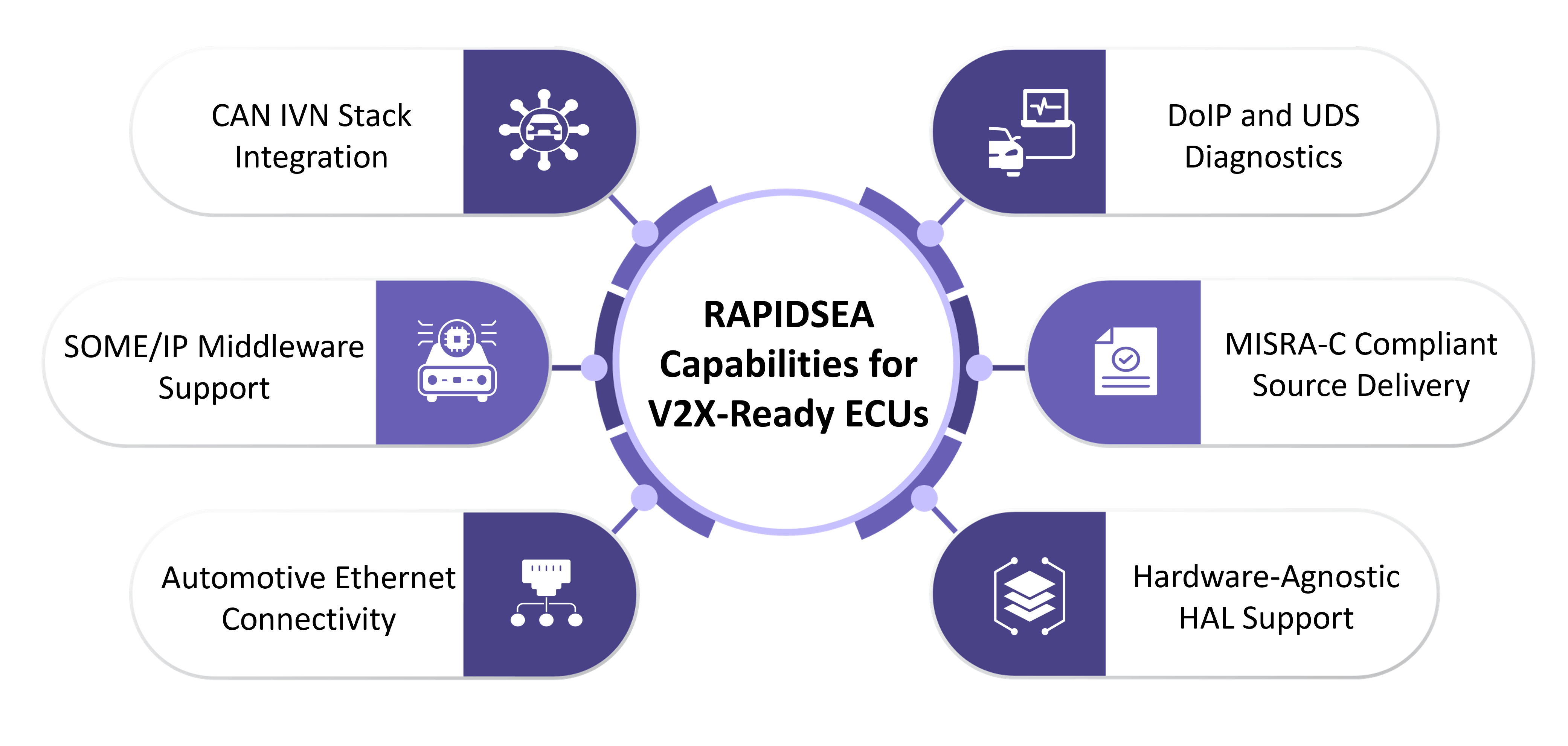
The DoIP and UDS stacks support diagnostic access to V2X ECUs for certificate management updates, firmware programming, and configuration services. RAPIDSEA's MISRA-C compliant source delivery and hardware-agnostic HAL support the diversity of MCU platforms used across V2X gateway and domain controller designs.
Conclusion
V2X communication extends automotive embedded software beyond the vehicle boundary into a complex ecosystem of standards, radio technologies, and security infrastructure. The most important groundwork is understanding which radio access technology the programme has selected, which regional message standard applies, and how the V2X stack's security requirements interact with the HSM and certificate management capabilities of the target ECU platform.
RAPIDSEA's in-vehicle communication stack provides the internal network infrastructure that V2X-enabled ECUs require — enabling embedded teams to focus their integration effort on the V2X-specific layers while building on a proven, hardware-portable foundation.
Ready to discuss V2X ECU integration? Contact us to request an evaluation build or book a technical demo.