
Automotive ECUs have followed processor industry trends toward multi-core architectures for compelling reasons. A single-core ECU handling powertrain control, diagnostics, network management, and OTA coordination simultaneously faces fundamental timing conflicts — safety-critical control loops compete for CPU time with lower-priority communication tasks. Multi-core microcontrollers resolve this by providing hardware-enforced partitioning: safety-critical functions run on dedicated cores with guaranteed timing, while application and communication tasks run independently without creating interference.
Modern automotive MCUs — the Renesas RH850/U2A, NXP S32K3, and Infineon AURIX TC3xx families — routinely offer two to six cores per device. For embedded software teams, this hardware capability creates both an opportunity and a significant design challenge. How cores are partitioned, how they communicate, and how the bootloader initialises them correctly are engineering decisions with lasting consequences for system safety, performance, and maintainability.
Why Multi-Core Matters in Automotive ECU Design
The primary motivation for multi-core ECU architecture is isolation. ISO 26262 functional safety requirements mandate freedom from interference between ASIL-classified and QM software components. Multi-core hardware provides a cleaner solution: an ASIL D function executing on Core 0 is physically isolated from a QM application running on Core 1, with hardware memory protection units enforcing the boundary.
A secondary motivation is performance. Modern ECUs combining gateway functions, diagnostics, motor control, and connectivity cannot meet their combined timing requirements on a single core without careful analysis showing sufficient headroom. The third motivation is future-proofing: software-defined vehicle architectures increasingly consolidate functions that previously ran on separate ECUs, and multi-core isolation between those functions becomes architecturally essential.
Core Partitioning Strategies
The fundamental partitioning decision in multi-core ECU software is which functions run on which cores. Several strategies are used in production automotive systems:
- Safety-application separation - Core 0 hosts all safety-critical software including closed-loop control and safety monitors. Core 1 hosts application and communication software at QM level. Memory protection hardware enforces that Core 1 cannot access Core 0's memory regions.
- Functional domain partitioning - each core handles a specific communication domain. Core 0 manages CAN and LIN networks, Core 1 manages Ethernet and SOME/IP services. Common in gateway and domain controller ECUs.
- Master-satellite partitioning - one core acts as supervisor handling system startup, power management, watchdog supervision, and inter-core coordination. Satellite cores handle specific processing tasks and report status to the master.
Inter-Core Communication: Mechanisms and Considerations
Once cores are partitioned, communication between them must be designed carefully. Shared memory with spinlocks is the simplest mechanism but carries the risk that a core holding a spinlock while preempted can block the other core indefinitely — problematic in hard real-time applications. Message passing through hardware inter-core FIFOs avoids this issue by queueing messages between cores without requiring spinlocks. Modern automotive MCUs provide hardware-accelerated inter-processor communication peripherals for this purpose.
Inter-core interrupts notify a receiving core that data is available without polling. Combined with shared memory or hardware FIFOs, inter-core interrupts allow event-driven inter-core communication with minimal CPU overhead. Regardless of mechanism, all shared data between cores must be declared volatile and memory barriers must be inserted at appropriate points to ensure hardware memory ordering guarantees.
Multi-Core Bootloader Design
At power-on, the hardware state defines which core starts executing first — typically Core 0 alone, with secondary cores held in reset. A robust multi-core bootloader architecture uses a Primary Bootloader on Core 0 that handles hardware initialisation, memory controller setup, and the UDS or XCP programming interface. The PBL validates each core's application image independently before releasing secondary cores from reset, preventing a corrupted image on a secondary core from causing undefined behaviour.
Anti-rollback protection, firmware signature verification, and secure boot key management apply per-core. A/B partition schemes applied per-core ensure that a failed update leaves the previous working image available for fallback, with the PBL managing which image slot is active for each core independently.
Implementing Multi-Core ECU Software with RAPIDSEA
RAPIDSEA supports multi-core ECU development through its hardware abstraction layer and protocol stack architecture. Protocol stacks including UDS, DoIP, SOME/IP, J1939, and CAN IVN are independently instantiable per core. The handle-based architecture allows the same stack binary to run on multiple cores with independent configuration and independent execution context — no global state is shared between instances.
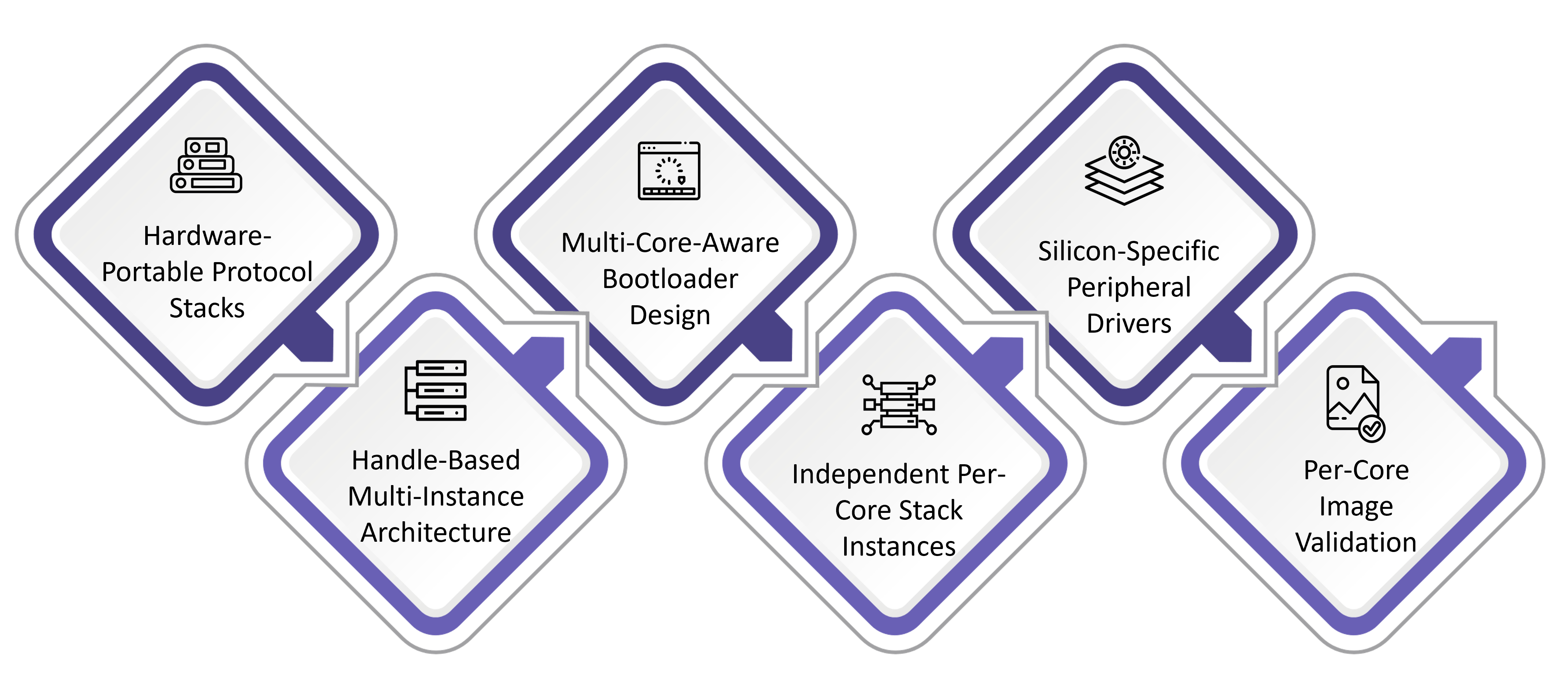
The HAL provides silicon-specific peripheral drivers for Renesas RH850/U2A, NXP S32K3, and Infineon AURIX TC3xx multi-core devices, abstracting inter-core peripheral access patterns so application code remains portable across MCU families. The bootloader suite supports PBL-plus-SBL architecture for multi-core startup sequences, with per-core image validation and configurable secondary core release logic.
Conclusion
Multi-core ECU software architecture is now a fundamental requirement for competitive automotive embedded development. Getting partitioning strategy, inter-core communication mechanisms, and bootloader sequencing right at architecture stage prevents costly rework when safety assessment and timing analysis begin.
RAPIDSEA's hardware-portable protocol stacks, handle-based multi-instance architecture, and multi-core-aware bootloader design give embedded teams a validated software foundation that accelerates multi-core ECU development.
Ready to explore multi-core ECU architecture for your next project? Connect with our team to discuss your requirements and discover how RAPIDSEA can accelerate development.